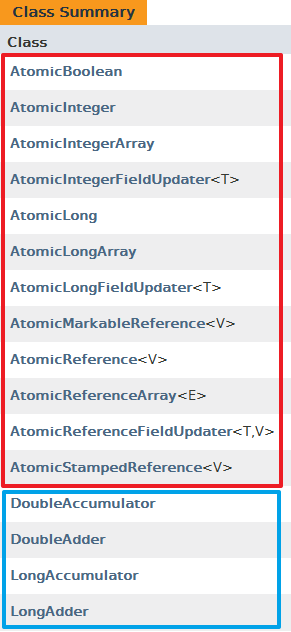
原子类
基本类型原子类
包含
AtomicIntegerAtomicBooleanAtomicLong
示例
50个线程,每个线程对MyNumber执行1000次自增,所有线程完成后输出结果
1
2
3
4
5
6
7
8
9
10
11
12
13
14
15
16
17
18
19
20
21
22
23
24
25
26
27
28
29
30
31
32
class MyNumber { public AtomicInteger atomicInteger = new AtomicInteger (); public void addPlusPlus () { atomicInteger.getAndIncrement(); } } public class AtomicAPITest { public static final int SIZE = 50 ; public static void main (String[] args) throws InterruptedException { MyNumber myNumber = new MyNumber (); CountDownLatch countDownLatch = new CountDownLatch (SIZE); for (int i = 0 ; i < SIZE; i++) { new Thread (() -> { try { for (int j = 0 ; j < 1000 ; j++) { myNumber.addPlusPlus(); } } finally { countDownLatch.countDown(); } }, String.valueOf(i)).start(); } countDownLatch.await(); System.out.println(Thread.currentThread().getName() + "\t" + myNumber.atomicInteger.get()); } }
数组类型原子类
包含
AtomicIntegerArrayAtomicLongArrayAtomicReferenceArray
引用类型原子类
AtomicReference
1
2
3
4
5
6
7
8
9
10
11
12
13
14
15
16
17
18
19
20
21
22
23
24
25
26
27
28
29
30
31
32
33
34
35
36
37
38
39
40
41
public class SpinLockDemo { private AtomicReference<Thread> atomicReference = new AtomicReference <>(); public void lock () { Thread thread = Thread.currentThread(); System.out.println(thread.getName() + " come in" ); while (!atomicReference.compareAndSet(null , thread)) { System.out.println(thread.getName() + " spin lock-----" ); } } public void unlock () { Thread thread = Thread.currentThread(); atomicReference.compareAndSet(thread, null ); System.out.println(thread.getName() + " finished" ); } public static void main (String[] args) { SpinLockDemo spinLock = new SpinLockDemo (); new Thread (() -> { spinLock.lock(); try { TimeUnit.SECONDS.sleep(3 ); } catch (Exception e) { e.printStackTrace(); } spinLock.unlock(); }, "A" ).start(); try { TimeUnit.MICROSECONDS.sleep(10 ); } catch (Exception e) { e.printStackTrace(); } new Thread (() -> { spinLock.lock(); spinLock.unlock(); }, "B" ).start(); } }
AtomicStampedReference
携带版本号(version)的引用类型原子类,可解决 CAS 的ABA问题
AtomicStampedReference(V initialRef, int initialStamp)
解决修改过多少次的问题
状态戳原子引用
AtomicMarkableReference
携带标记位(flag)的引用类型原子类
AtomicMarkableReference(V initialRef, boolean initialMark)
解决是否修改过的问题,将状态戳简化为true/false,一次性的标记
状态戳(true/false)原子引用
对象的属性修改原子类
包含
AtomicIntegerFieldUpdater:原子更新对象中volatile int类型字段的值AtomicLongFieldUpdater:原子更新对象中volatile long类型字段的值AtomicReferenceFieldUpdater:原子更新对象中volatile引用类型字段的值
使用目的
使用要求
更新的对象属性必须使用public volatile修饰**(此处也是volatile的使用场景)**
因为对象的属性修改原子类都是抽象类 ,所以每次使用都必须使用静态方法newUpdater()创建一个更新器,并且需要设置想要更新的类和属性
示例
AtomicIntegerFieldUpdater为例
1 2 3 4 5 6 7 8 9 10 11 12 13 14 15 16 17 18 19 20 21 22 23 24 25 26 27 28 29 30 31 32 33 34 35 36 37 38 39 40 41 42 class BankAccount { String bankName = "CCB" ; public volatile int money = 0 ; AtomicIntegerFieldUpdater<BankAccount> atomicIntegerFieldUpdater = AtomicIntegerFieldUpdater.newUpdater(BankAccount.class, "money" ); public void transfer () { atomicIntegerFieldUpdater.getAndIncrement(this ); } } public class AtomicIntegerFieldUpdaterTest { public static void main (String[] args) throws InterruptedException { BankAccount bankAccount = new BankAccount (); CountDownLatch countDownLatch = new CountDownLatch (10 ); for (int i = 0 ; i < 10 ; i++) { new Thread (() -> { try { for (int j = 0 ; j < 1000 ; j++) { bankAccount.transfer(); } } finally { countDownLatch.countDown(); } }, String.valueOf(i)).start(); } countDownLatch.await(); System.out.println(Thread.currentThread().getName() + "\t" + "result: " + bankAccount.money); } }
AtomicReferenceFieldUpdater为例
1 2 3 4 5 6 7 8 9 10 11 12 13 14 15 16 17 18 19 20 21 22 23 24 25 26 27 28 29 30 31 32 33 34 35 36 37 class MyVar { public volatile Boolean isInit = Boolean.FALSE; AtomicReferenceFieldUpdater<MyVar, Boolean> referenceFieldUpdater = AtomicReferenceFieldUpdater.newUpdater(MyVar.class, Boolean.class, "isInit" ); public void init () { if (referenceFieldUpdater.compareAndSet(this , Boolean.FALSE, Boolean.TRUE)) { System.out.println(Thread.currentThread().getName() + "\t" + "----- start init" ); try { TimeUnit.SECONDS.sleep(2 ); } catch (Exception e) { e.printStackTrace(); } System.out.println(Thread.currentThread().getName() + "\t" + "----- over init" ); } else { System.out.println(Thread.currentThread().getName() + "\t" + "----- other thread is working" ); } } } public class AtomicReferenceFieldUpdaterTest { public static void main (String[] args) { MyVar myVar = new MyVar (); for (int i = 0 ; i < 5 ; i++) { new Thread (myVar::init, String.valueOf(i)).start(); } } }
原子操作增强类
包含
DoubleAccumulatorDoubleAdderLongAccumulatorLongAdder
区别
LongAdder只能用来计算加减法,且从零开始计算LongAccumulator则提供了自定义的函数操作
阿里开发要求
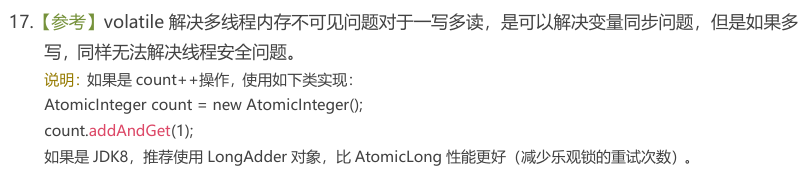
如果是 JDK8,推荐使用LongAdder对象 ,比AtomicLong性能更好(减少乐观锁的重试次数)
示例
热点商品点赞计数器,点赞数加加统计,不要求实时精确
对比四种实现方法的性能:synchronized,AtomicLong,LongAdder,LongAccumulator
1 2 3 4 5 6 7 8 9 10 11 12 13 14 15 16 17 18 19 20 21 22 23 24 25 26 27 28 29 30 31 32 33 34 35 36 37 38 39 40 41 42 43 44 45 46 47 48 49 50 51 52 53 54 55 56 57 58 59 60 61 62 63 64 65 66 67 68 69 70 71 72 73 74 75 76 77 78 79 80 81 82 83 84 85 86 87 88 89 90 91 92 93 94 95 96 97 98 99 100 101 102 103 104 105 106 107 108 109 110 111 112 113 114 class ClickNumber { int number = 0 ; public synchronized void clickBySynchronized () { number++; } AtomicLong atomicLong = new AtomicLong (0 ); public void clickByAtomicLong () { atomicLong.getAndIncrement(); } LongAdder longAdder = new LongAdder (); public void clickByLongAdder () { longAdder.increment(); } LongAccumulator longAccumulator = new LongAccumulator ((x, y) -> x + y, 0 ); public void clickByLongAccumulator () { longAccumulator.accumulate(1 ); } } public class AccumulatorCompareDemo { public static final int _1W = 10000 ; public static final int threadNumber = 50 ; public static void main (String[] args) throws InterruptedException { ClickNumber clickNumber = new ClickNumber (); long start; long end; CountDownLatch countDownLatch1 = new CountDownLatch (threadNumber); CountDownLatch countDownLatch2 = new CountDownLatch (threadNumber); CountDownLatch countDownLatch3 = new CountDownLatch (threadNumber); CountDownLatch countDownLatch4 = new CountDownLatch (threadNumber); start = System.currentTimeMillis(); for (int i = 0 ; i < threadNumber; i++) { new Thread (() -> { try { for (int j = 0 ; j < 100 * _1W; j++) { clickNumber.clickBySynchronized(); } } finally { countDownLatch1.countDown(); } }, String.valueOf(i)).start(); } countDownLatch1.await(); end = System.currentTimeMillis(); System.out.println("costTime: " + (end - start) + " ms" + "\t clickBySynchronized: " + clickNumber.number); start = System.currentTimeMillis(); for (int i = 0 ; i < threadNumber; i++) { new Thread (() -> { try { for (int j = 0 ; j < 100 * _1W; j++) { clickNumber.clickByAtomicLong(); } } finally { countDownLatch2.countDown(); } }, String.valueOf(i)).start(); } countDownLatch2.await(); end = System.currentTimeMillis(); System.out.println("costTime: " + (end - start) + " ms" + "\t clickByAtomicLong: " + clickNumber.atomicLong.get()); start = System.currentTimeMillis(); for (int i = 0 ; i < threadNumber; i++) { new Thread (() -> { try { for (int j = 0 ; j < 100 * _1W; j++) { clickNumber.clickByLongAdder(); } } finally { countDownLatch3.countDown(); } }, String.valueOf(i)).start(); } countDownLatch3.await(); end = System.currentTimeMillis(); System.out.println("costTime: " + (end - start) + " ms" + "\t clickByLongAdder: " + clickNumber.longAdder.sum()); start = System.currentTimeMillis(); for (int i = 0 ; i < threadNumber; i++) { new Thread (() -> { try { for (int j = 0 ; j < 100 * _1W; j++) { clickNumber.clickByLongAccumulator(); } } finally { countDownLatch4.countDown(); } }, String.valueOf(i)).start(); } countDownLatch4.await(); end = System.currentTimeMillis(); System.out.println("costTime: " + (end - start) + " ms" + "\t clickByLongAccumulator: " + clickNumber.longAccumulator.get()); } }
1
2
3
4
costTime: 933 ms clickBySynchronized: 50000000 costTime: 586 ms clickByAtomicLong: 50000000 costTime: 76 ms clickByLongAdder: 50000000 costTime: 69 ms clickByLongAccumulator: 50000000
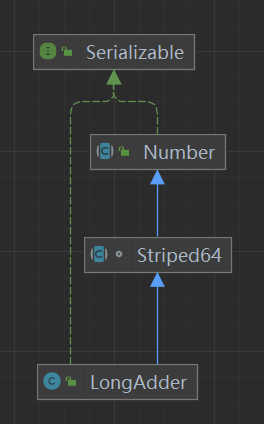
LongAdder 源码分析
LongAdder性能优于AtomicLong的原因
LongAdder的基本思路是分散热点 ,用空间换时间,将value值分散到一个Cell数组中,不同线程会命中到数组的不同槽中,各个线程只对自己槽中的那个值进行 CAS 操作,这样热点就被分散了,冲突的概率就小很多;如果要获取真正的long值,只要将各个槽中的变量值累加返回
在无竞争的情况下,LongAdder和AtomicLong一样,对同一个base进行操作
多个线程需要同时对value进行操作时,可以对线程 id 进行 hash 得到 hash 值,再根据 hash 值映射到Cell数组的某个下标,再对该下标对应的值进行自增操作
当所有线程操作完毕,将数组Cell的所有值和base都加起来作为最终结果
sum()会将所有Cell数组中的value和base累加作为返回值,核心的思想就是将之前AtomicLong一个value的更新压力分散到多个value中去,从而降低更新热点
base变量:低并发,直接累加到该变量上Cell[]数组:高并发,累加进各个线程自己的槽Cell[i]中则最终的和为:$Value=Base+\sum_i^nCell[i]$
longAdder.increment() 为例
add(1L)
如果Cell[]数组为空,尝试用 CAS 更新base字段,成功则退出;
如果Cell[]数组为空,CAS 更新base字段失败,出现竞争,uncontended为true,调用longAccumulate
如果Cell[]非空,但当前线程映射的槽为空,uncontended为true,调用longAccumulate
如果Cell[]非空,且当前线程映射的槽非空,CAS 更新Cell的值,成功则返回,否则,uncontended为false,调用longAccumulate
longAccumulate()
首先给当前线程分配一个hash值,然后进入一个for(;;)自旋,这个自旋分为三个分支:
CASE 1:Cell[]数组已经初始化了
CASE 2:Cell[]数组未初始化(首次新建),则尝试对它加锁,并初始化Cell[]数组
CASE 3:Cell[]数组正在初始化中,则尝试直接在基数base上进行累加操作
sum()
会将Cell[]数组中的value和base累加作为返回值
其返回值不是原子性的快照,在并发情况下并非准确值
LongAdder 与 AtomicLong 的对比
AtomicLong
线程安全,可允许一些性能损耗,要求高精度时可使用
保证精度,牺牲性能作为代价 AtomicLong是多个线程针对单个热点值value进行原子操作
LongAdder
当需要在高并发下有较好的性能表现,且对值的精确度要求不高时,可以使用
保证性能,牺牲精度作为代价 LongAdder是每个线程拥有自己的槽,各个线程一般只对自己槽中的那个值进行 CAS 操作
总结
AtomicLong
原理
CAS + 自旋
常用方法为incrementAndGet()
场景
低并发下的全局计算
AtomicLong能保证并发情况下计数的准确性,其内部通过 CAS 来解决并发安全性的问题
缺陷
高并发后性能急剧下降
原因:AtomicLong的自旋会成为瓶颈,N个线程 CAS 操作修改值,每次只有一个成功过,其他N-1失败,失败的线程会不断自旋直到成功,这样大量失败自旋,会导致CPU占用率升高
LongAdder
原理
CAS + Base + Cell数组分散热点
空间换时间,并分散了热点数据
场景
缺陷
sum求和后还有计算线程修改结果的话,最后jie’guo